[page 2]
Directed by Steve Schrum
Costumes Designed and Constructed by Dianna L Bourke
Special Appearance by: The Outpatients
The Time:the present. The Place: a room in a private clinic.
There will be one ten-minute intermission.
Produced by special arrangement with Bakers' Plays, Boston, MA.
Audience members are requested to refrain from taking photographs or using any type of recording devices during the performance.
[page 3]
Many members of the Tech Crew receive credit for Theatre 297, Theatre in Production.
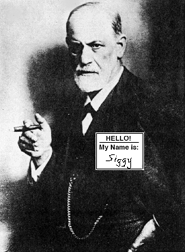
This program was created entirely on computer. Michael Foster at the IBM Almaden Research Center in San Jose, CA, scanned in the photograph of Sigmund Freud using an HP ScanJet IIC scanner connected to an IBM PS/2 Model 80, and sent it electronically to Steve Schrum over the Internet. Steve altered the scanned photo with Expert Color Paint on a Macintosh LCII, and imported the finished graphic into Microsoft Word. A Macintosh Personal LaserWriter LS printed the final product.
[page 4-5]
Darlene Sweet (Geraldine Barclay), a sophomore Physical Therapy major from Hazleton, is also co-president of Students for Environmental Awareness‹Highacres here on campus. Darlene is making her acting debut in this show.
Stacey Love (Mrs. Prentice) i5 a freshman from Wilkes-Barre, PA. In high school, she appeared in both Grease and Dracula: The Musical.
Michael Brewster (Nicholas Beckett) is also making his acting debut with What The Butler Saw. A freshman Nursing major from Philadelphia, Mike gives voice lessons and directs the gospel choir "Proclaimers of Hope" here at the Hazleton campus.
Jason Harriss Vichinsky (Dr. Rance) is a sophomore from Brooklyn, NY, majoring in Political Science. Previous acting credits include Macduff In Macbeth and Iago in Othello. He returns to our stage following his appearance last spring as Alceste in The Misanthrope.
Keith Fernsler (Sergeant Match) is a freshman Chemical Engineering major from Bloomsburg, PA. Keith is making his acting debut with this show.
Heather Dickinson (Stage Manager) comes to us from Harrisburg, PA, and is a freshman Film and Video major. In high school, Heather worked on the stage crew and directed two plays. She also appeared in productions of Guys and Dolls, The Music Man and Godspell.
Christopher Knapp (Technical Director) is a second year Engineering major at Penn State. He has three years of high school drama experience including props, lighting and sound design for such shows as Grease, My Fair Lady and the female version of The Odd Couple. Chris appeared as the DJ and designed lighting for last spring's production of The Misanthrope.
Susanne Munford (Assistant Director) is a Secondary Ed/English major with a minor in Theatre. In high school she acted in Fiddler on the Roof and served as Assistant Director for Tartuffe, The Rainmaker, Cactus Flower, and The King and I.
Dave Avillion (Musical Director) is a sophomore Education major. A native of Hazleton, Dave has played drums in area bands for four years, and last summer appeared at the J.J. Ferrara Performing Arts Center. He formed the band The Outpatients for this production.
Steve Schrum (Director) is, while teaching theatre courses here on the Hazleton campus, is writing his dissertation for a Ph.D. in directing from the University of California, Berkeley Department of Dramatic Art. His other directing credits include Moliere's The Misanthrope here on the Hazleton campus last spring, along with: The Importance of Being Earnest at the York (PA) Little Theatre; and, at Berkeley, plays by Sam Shepard, Shakespeare, and Shaw. Ten years ago he wrote his master's thesis on What The Butler Saw, and finally has gotten the opportunity to direct it. (An excerpt from the thesis appears in this program under the heading, "About the Author.")
Dianna Bourke, PhD. (Costume Designer), although an assistant professor of Biology here at the Hazleton campus, still finds time to design costumes. Late night production meetings are considerably easier to schedule since she is conveniently married to the director! While a University Park undergraduate, Dianna "minored" in Theatre with a concentration in costume design and construction. She has designed costumes for The King And I at the White Barn Theatre in Irwin, PA, and for last year's production of The Misanthrope.
[page 6]
With this creative the outlet established for him, Orton decided to continue in the theatre, and entered the Royal Academy of Dramatic Art (RADA) in 1951. While at RADA he met Kenneth Halliwell, who would become his lover, his co-conspirator in defacing public library books (for which both were jailed in 1962), the co-author of several unpublished novels such as The Boy Hairdresser, and finally his partner in death in 1967 when Halliwell battered Orton's skull with a hammer and then committed suicide, apparently from personal and professional jealousy fostered by Halliwell's neurotic mind.
Before his death, Orton, the ever-unfaithful, ever-Dionysian rebel against society, wrote four one-act plays, three full-length plays, a novel, a sketch included in the revue Oh Calcutta and a film script for the Beatles ("Up Against It") which was never produced. Critical reaction to his work was always mixed, condemning the largely sexual content of his plays, but praising the craft involved in his works. However, in the past few years, numerous productions of his plays, including What The Butler Saw, have been mounted through out the United States, owing to the growing acceptance and popularity of Joe Orton's works. Perhaps this is a recognition of archetypes included in the plays and the "joy" that Orton's prankster spirit creates (Lahr, p. 28). In any event, Orton raised farce "beyond banality" (Joan F. Dean, "Joe Orton and the Redefinition of Farce," Theatre Journal, 34, p. 492) by utilizing classical drama in his plays.
--From Stephen A. Schrum, "Classical Elements of Plot and Character in Joe Orton's What The Butler Saw," Master's Thesis, Ohio State University, 1983, p. 1.
[page 7-8]
In a time when the thoughtless and selfish actions of anyone can spread disease and destruction, we must take greater care to safeguard our future. As individuals, we need to find a middle ground, to merge our Dionysian creative side and our Apollonian classical side to create a safer and better lives for ourselves and for those around us.
"Through their rites, Dionysian worshipers sought a mystical union with the primal creative urge. On a more practical level, they sought to promote fertility, to guarantee the return of the spring, the productivity of both humans and the land, and ample harvests.... "The rites often included a procession with a chorus who sang and danced as they carried large phallic symbols (representing male sexual organs) aloft on poles."
PENTHEUS: I would pay a great sum to see that sight.
DIONYSUS: Why are you so passionately curious?
PENTHEUS: Of course I'd be sorry to see them drunk--
DIONYSUS: But for all your sorrow, You'd like very much to see them?... Shall I lead you there now? Are you ready to go?
PENTHEUS: The sooner the better. The loss of even a moment would be disappointing now.
DIONYSUS: First, however, you must dress yourself in women's clothes.
PENTHEUS: What? You want me, a man, to wear a woman's dress? But why?
DIONYSUS: If they knew you were a man, they'd kill you instantly.
PENTHEUS: True. You are an old hand at cunning, I see.
DIONYSUS: Dionysus taught me everything I know.
DIONYSUS Who now revolts against divinity in me, Thrusts me from his offerings, forgets my name in his prayers. Therefore shall I prove to him and every man in Thebes that I am god indeed.
TEIRESIAS Do not be so certain that power is what matters in the life of man; do not mistake for wisdom the fantasies of your sick mind.
DR. RANCE "l am a representative of order, you of chaos.... We've a link here with primitive religion. Why have you turned your back on the God of your fathers?"