Buttcracks and Willful Ignorance:
About the Stories
Section 1: Searching for a Voice |
|
"The
Threshold to Light" (1977) |
began its life as a play, but it didn't quite work. It's an idea I carried around for years, and finally made click in this form. |
"Oh,
Galatea" (1977) |
resulted from my employment at the Hysterical Society of York County (as it was commonly known by its employees). I did pass the mannequins almost daily, but I didn't try to get involved. The father mannequin stared at me as I passed, and only ever allowed me to photograph the inspiration for the story (see photo, below). For a taped presentation for Ed Debes I later became the president of the Acme Mannequin Corporation, the world's largest manufacturer of anatomically-correct mannequins, but only for a day. |
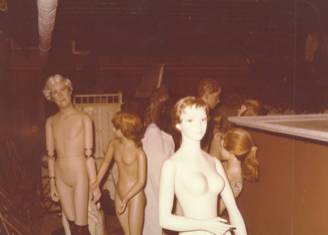 |
|
"The
Stradivarius Incident" (1977) |
is
also from my janitorial period. Imagination took over where the real
event—someone wanting to donate a violin—ended. |
"The
American Dream Girl" (1978) |
is
the short story version of a one-act play of the same name. Back in those
days, one-act plays were flying out of my portable typewriter.
The title comes from a hooker passing me on the street, a seedy man on
her hip, both with arms around each other, and her saying Joyce's line:
"Am I the girl of your dreams?" |
"A
Dragon's Tears" (1982) |
comes out of many Dungeons and Dragons sessions while living in Columbus, OH. I thought I would try my hand at fantasy fiction, since I had created an entire planet (Erstworld) as a Dungeon Master for our games. |
"Love
on the Ninth Floor" (1981) |
is
really more a thumbnail sketch than a story, and is an accurate description
of one morning on the ninth floor of Hardwick Hall, Temple University. |
"Larry" (1982) |
is a short character sketch; see below. |
"Sharon" (1982) |
is a short character sketch; see below. |
"The
Truckdriver" (1982) |
was to be part of another novel. The concept came from my reading of John Barth, and I intended to construct a novel from individual short stories. "Larry" and "Sharon" were also to be parts of it, the inspiration from observations of people at bars. Obviously it was never finished. |
"A
Part of the Order" (1982) |
is
a fragment of a longer story which I seem to have lost. I must have been
reading Ayn Rand at the time. |
"Ternwood
in Anger" (1982) |
is
a parody of romance novel. I began to notice, from talking to women who
read them, that the plots are pretty much basically always the same. The
advantage to this is that I've done in a few pages what romance novelists
need a whole book for. |
"If
Thou Dost Break Her Virgin Knot" (1982) |
is
the true story of a friend of mine, embellished by the finding of the
virginity in the flesh. The story served as the basis of another of my
plays, Amanda. |
"God's
in His Heaven" (1982) |
is
an idea about what's wrong with the world and how it might be repaired.
Besides being an allegory, it seems to predate Kevin Smith's film Dogma
by a few years. |
"Gilbert
the Goldfish" (1983) |
is a project that continued for decades. I |
"We
Are All Streetlamps!" (1983) |
are the liner notes to the album that never got produced. We did record a few tracks (including "Aura" and "Indulgences by Mail," but we scattered before completing the project. |
Section
2: Character Voices |
|
"Aliens!
3 Miles, Turn Left" (1994) |
written as a long fascination with this whole alien thing I had been introduced to in Carl Jung's book on flying saucers. I directed and designed the monologue's premiere at the Penn State University Hazleton Campus in Hazleton, PA, on November 9, 1994. David A Scopinich played The Man. |
"Aura" (1977) |
is
a commercial starring Pope Innocent XIII. I wrote it for an assignment
in my audio production class. Imagine a Gregorian chant in the background
as you read it. |
"I
Wish I Was In Dixie" (1996) |
is an odd "performance piece" that resulted from my experiences doing the artificial insemination thing in the "Collection Room." It's difficult to get emotionally and intimately involved with a cup on such short notice and in such (pardon the pun) sterile surroundings. |
"Joiners" (2004) |
tells the story of two brushes with other "joiners"
and how I determined that I do not fall into that category. And it's all
true...even the blue feet. |
"Go Fightin' Broilers" (2003) |
is just another one of those quick character sketch monologues I came up with on the road. |
"Soar
Like the Hawk" (2004) |
came to me as I was making a solo drive to York, PA to visit my mother. It's one of those pieces that, if someone asked me to explain what the moral of the story is, I would have to ask what they thought it is. Because it has several possible meanings, and it is up to the reader to select the one he or she prefers. |
"Stigmata"
(2004) |
is
another quick character sketch. The inspiration came while parking at
my dermatologist's for an appointment. I suddenly wondered what he would
do if confronted with a case of stigmata, and then I focused it back on
the bearer of the problem. |
"URWhatUDrive"
(2003) |
is
"almost" a true story. The circumstances are essentially true,
though I did not communicate with anyone in other cars. |
"Security
Noir" (2003) |
grew
out of watching "The Door Channel." My mother lives in a downtown
senior citizen high rise, and the administrators there have always been
very interested in maintaining security for the building. Two steps they
have taken in recent years have been the hiring of a security agency to
provide guards for the evening hours, and the installation of video cameras
above the front and back doors. What the cameras see is available to all
residents on their TVs through cable channel 16. My wife and I have dubbed
this ³The Door Channel.² One can sit and watch the comings and goings
(or absolutely nothings) of the residents, security guards—and paramedics,
if the need arises—24 hours a day. That¹s in seven-second increments,
incidentally, since the cameras switch from the front door to the back
door to the front door, every seven seconds. |
"Security
Noir 2" (2003) |
seemed like a good idea, since sequels are big business. My one brother-in-law suggested the premise, and I populated it with a second security guard based on my cousin who did, in fact, work as a guard in the building at one time. |
"Email
Intercept" (2003) |
was a joke email I sent to some people after receiving dozens (at least) of those annoying messages from spammers who wanted my bank account number, and upon hearing of a planned influx of Nigerians students to my school. These messages seemed to have tapered off in favor of allowing me to buy Viagra and Vicodin online. |
"Catholic
School Girl" (2003) |
is
an excerpt for a planned novel (and I just need the time to write it!)
entitled The Chaos of Dreams. The novel deals with
an English professor dealing with a mid-life crisis through the
use of a dream journal. Interwoven between his dreams are events that
relate to the dreams. |
"Redress"
(2003) |
is
another excerpt from The Chaos of Dreams. In the book, it's one of the real events—or is it, too, a dream? |
"Inflate-A-Santa" (2003) |
is all true, as reported to a friend using Instant Messenger. |
Section
3: Finding Oneself |
|
"Immaculate
Misconceptions" (2004) |
is a monologue about my experiences in Catholic grade and high school. Part of the message of the piece is how many events of one's life add up to who we have become. The same is true of the stories in this volume. I performed the world premiere reading on April 23, 2004 for an audience of 20. |
Email Steve Schrum; Return to the MUSOFYR Table of Contents